
Let me tell you a story.
Once upon a time, I worked a day job and dreamed about writing a book. I would work on my project occasionally and not work on it more often. By the time I was 30 years old, I’d been writing for about fifteen years but had only completed three manuscripts.
Then, something switched, and in the last six years I’ve completed 11!
Maybe you’re like me and need to figure out how to keep writing consistently and actually reach “The End” on your project. Whether that project is a short story or a full-length novel, these seven proven strategies will help you build momentum and finish your manuscript.
1. Join a Writing Community
This is honestly the best thing I ever did. I joined an online writing community, and within that space, I found like-minded people who were all trying to do the same thing as I was. Some were already doing it.
Whether you join a writing group on Discord, Facebook, or meet in person at your local library, having a writing community is transformative.
What are the benefits?
- Accountability: For me, external motivation helps keep me going. Having real people as writing partners or accountability partners keeps me on track even on days when motivation is low. Additionally, you could make a public commitment to complete your draft by a certain date and have that external force keeping you motivated.
- Brainstorming: Sometimes, when I’m stuck, I just need to talk it out. So I find one of my writing friends and talk through the problem. Usually, they don’t even need to offer solutions—I just need to hear the problem out loud for my own brain to come up with a fix. However, some of my best ideas have come from other people helping me get there.
- Critiques: The way I define critiques is someone who is reading and offering feedback as you’re drafting. Finding a critique partner can be highly motivating. Someone who is waiting for the next chapter and ready to talk about where the story is going as you’re writing it can help you push through when you might otherwise get stuck on your own.
2. Create a Sustainable Writing Routine
For some people, a consistent writing routine is everything. Sometimes that means writing every single day. Sometimes that means writing every Monday at 6pm for one hour. Whatever routine works best for you is the one you should stick to.
The key to keeping a writing routine is making it realistic for your life. A routine you can’t maintain is worse than no routine at all.
It’s also important to remember that routines can be adjusted. You can change from writing one day per week to five or from seven down to three. The important thing is to start it so you have it built in.
3. Start with Ridiculously Small Goals
Speaking of starting, another thing I did to begin my writing routine was to aim low. I made a goal of writing just ten words per day. Some days I would write those ten words and be done. Sometimes it was a struggle. But other days, those ten words turned into a hundred, or even a thousand.
When you make your writing goal laughably easy, you remove the psychological barrier of “failure.” You build the habit first, and the word count follows. On the other hand, if you make the goal too hard, it’s easy to fail one day and decide it’s not worth doing because you’re just going to fail again, so what’s the point?

You also don’t have to choose a word count goal. You could set a time. Make the goal for 1 minute per day. Or make the goal “turn on my computer and open the project.” When I was getting into exercising, my goal was “put on my running shoes.” Once they were on my feet I would think, “Well, I’ve already got them on, might as well go for a run.” But if the goal is low, it’s easy to meet it and come back the next day to meet it again.
4. Remove Barriers to Writing
Make writing as frictionless as possible so when inspiration strikes, you have the means to follow it.
I use Scrivener to write my first draft, and the reason I use it is because I can have it on my computer and my phone. So if I’m out somewhere and have an idea, I can easily open the Scrivener app on my phone and type in the idea so I don’t lose it.
Here are some other ways to remove barriers:
- Keep your desk clear and your laptop charged and ready
- Keep a notebook and pen in your bag, car, or nightstand
- Set your computer to open your writing document on startup
- Use dictation software if typing feels like a barrier
- Download a writing app that syncs across all your devices
Whatever making it easy looks like for you is what you should do.
5. Embrace Change When Routines Stop Working
Sometimes, routines stop working. When this happens, you need to allow yourself to change. This can mean a few different things.
Change your format. Instead of typing, try writing longhand. Instead of writing a full-length novel, try writing a poem or short story. Sometimes the act of switching things up can help you grease those creative wheels to get them rolling again.
Change your project. Allow yourself to switch between projects—but be honest with yourself about whether this is helpful or just procrastination. If you’re the kind of person who likes to chase the next shiny thing, this might not be for you. But sometimes, I get a thought in my head that just won’t let go. When this happens, I allow myself to start a new document and write out the thoughts (notes, bits of dialogue, a full scene, or more) until it lets go and I can return to my current work in progress. I’ve learned to recognize which ideas are just fleeting thoughts versus stories that need my full attention.
Change your location. Sometimes a physical move can help creative movement as well. I find when I work in a café or at the library, the fact that my housework isn’t there to distract me lets me get into the creative zone much more easily.
6. Track Your Progress (All of It)
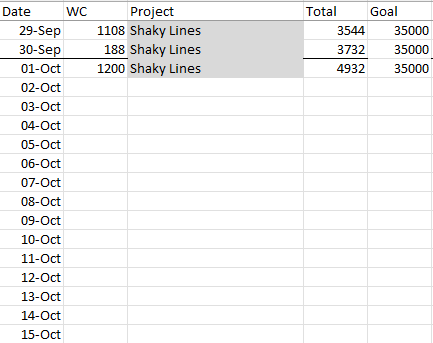
It’s hard to see the progress when it’s small, so keep track of what you’ve accomplished and remember to celebrate the wins. All of them.
I like to track my word counts when I’m drafting, but even more, I track when I’m editing as well. Otherwise, those editing days can feel like I haven’t done anything at all. Tracking your writing progress helps you see patterns in your productivity and shows you just how much you’re actually accomplishing.
You can track your progress in a spreadsheet, a bullet journal, apps like Pacemaker or Scrivener’s project targets, or even just a calendar where you mark an X for every day you write.
The most important thing? Don’t qualify your win statements. Instead of “I only got 1000 words this week,” say “I wrote 1000 words this week.” Own it.
7. Give Yourself Permission to Write Badly
Remember that you’re telling yourself the story first and it’s not for anyone but you. No one has to read your first draft, and that first draft is not your last. You can’t edit an empty page—but you can edit a messy one.
Use your own story to fuel yourself going forward. Let yourself get excited about what happens next, even if the sentences getting you there aren’t perfect yet. That’s what revision is for.
Feed the muse. Use other stories to inspire you. Read. Watch movies. Listen to music. Sometimes one lyric can be the inspiration for a whole story, or one scene in a film can unlock the solution to a problem you’ve been wrestling with in your manuscript.
Input fuels output. When you’re feeling stuck or uninspired, sometimes the best thing you can do is step away from your own work and consume someone else’s art.
Keep Writing, Keep Going
Finishing a manuscript is hard. But with the right strategies in place—a supportive community, a sustainable routine, achievable goals, and permission to write imperfectly—you can get there. I did, and so can you.
Once you’ve written “The End,” the next step is polishing that manuscript. I offer copy editing and proofreading services specifically for romance and fantasy authors. If you’re not quite ready for professional editing yet, check out other resources on types of editing and working with track changes.
Now stop reading and go write those ten words.

Leave a comment