You did it! You’ve just typed “The End” on your latest novel. Now you’re faced with a daunting task: editing. But what does that mean? There are many different stages of editing for authors and keeping them straight is sometimes confusing.
You’ve probably heard terms like developmental editing, copy editing, and proofreading thrown around, but what do they actually mean? These three distinct stages require different approaches and happen at different points in your road to publishing. By the end of this post, you’ll know exactly which type of editing your manuscript needs and when to invest in each one.
Before we dive in, remember that all editing is collaborative. Every suggestion an editor makes is just that—a suggestion. You’re the author, and you have the final say on what changes serve your story and your readers.
Developmental Editing
What does a developmental editor do?
Does your enemies-to-lovers arc feel rushed? Are your fantasy world’s rules clear and consistent? Your developmental editor is going to answer these questions by examining the overall structure and content of the manuscript, including:
- potential plot holes
- pacing
- story organization
- story theme
- character development
- relationship development
- romantic tension
- world-building consistency
- magic-system logic
A developmental editor might suggest major restructuring, cutting entire chapters or characters, or expanding undeveloped sections. They’re going to ask questions and point out areas in the manuscript that aren’t working the way you intended them to. A skilled developmental editor will also highlight your manuscript’s strengths, because it’s just as important to know where things are working as it is to know where they’re not.
What developmental editors don’t do
Developmental editing focuses on big-picture issues, not sentence-level problems or typos—these come later in the process.
When to start a developmental edit
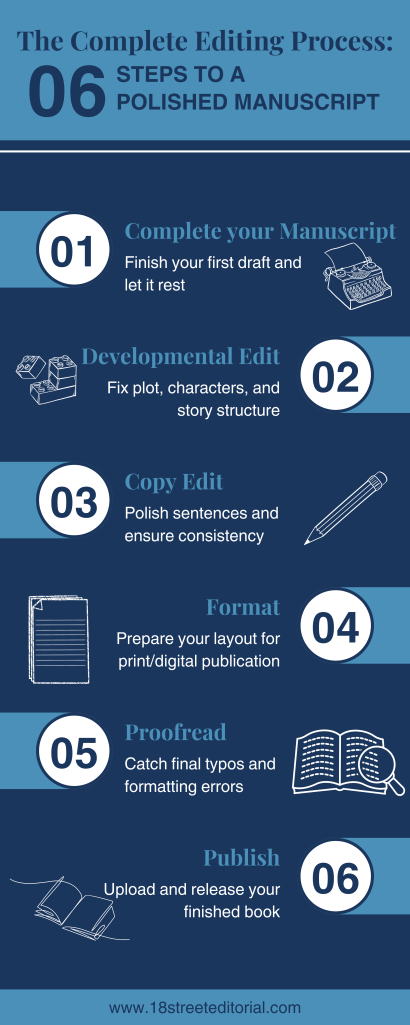
Developmental editing is the first step in the professional editing process. After completing your first draft, let your manuscript rest for a few weeks, then read it through once yourself. This is when you’ll want developmental feedback—whether from a critique partner, beta reader, or professional developmental editor. This big-picture editing must happen before copy editing or proofreading, as major structural changes could affect everything else.
Copy Editing
What does a copy editor do?
Your story is solid, your characters are compelling, and your plot flows beautifully. Now it’s time to make your prose shine. Copy editing services come after developmental editing and focus on clarity, consistency, and style at the sentence and paragraph level. Professional copy editors also catch grammatical errors and improve readability, going deeper than basic proofreading, examining the manuscript for the following things:
- awkward phrasing
- repetitive word choices
- inconsistent terminology
- adherence to style guide
- consistency in
- character names/nicknames
- timeline details
- world-building details
- formatting
For romance and fantasy authors, copy editors also ensure consistency in genre-specific elements like magic system terminology, character relationship timelines, and maintaining the appropriate tone for your heat level or fantasy setting.
Copy editing sometimes includes line editing (improving sentence flow and style), though some editors offer these as separate services. The terms are often used interchangeably, but both focus on polishing your prose after the big-picture issues are resolved.
What copy editors don’t do
A copy editor is not going to consider story-level problems. They focus on the sentence- and paragraph-level issues.
When to start a copy edit
Copy editing should only begin after you’ve implemented all developmental changes and are satisfied with your story’s structure, characters, and pacing. If you copy edit, then return to additional developmental editing, you will end up repeating steps unnecessarily, wasting time and money.
Proofreading
What does a proofreader do?
Your story is compelling, your sentences are polished, and you’re almost ready to publish. But first, let’s catch those sneaky typos hiding in plain sight. Nothing pulls a reader out of your carefully crafted story faster than a glaring typo, which is why this final step is so crucial. A professional proofreader is going to catch:
- typos
- spelling mistakes
- punctuation errors
- basic grammatical issues
- formatting inconsistencies (e.g., page numbers, headers, footers, chapter titles, etc.)
Some proofreaders will also catch some copy editing-level problems like adherence to the style guide and consistency in written details like character names. You don’t want your character to be named Shaun on page three and Shawn on page twenty. Proofreaders typically work with your final formatted manuscript—whether that’s a Word document ready for upload or a PDF of your print layout.
Proofreading assumes your content and language are solid. However, even after professional copy editing, new errors can creep in during revisions and formatting. It’s about catching the small errors that can distract readers and undermine your credibility.
What proofreaders don’t do
Like a copy editor, proofreaders don’t look at story-level problems. By this point, they should all be taken care of. Proofreaders are also not going to look at sentence-level, wording issues and won’t suggest rewrites or substantial changes.
When to start a proofread
Proofreading is the last step before publication. Generally, it should also happen after formatting the document so the proofreader can check things like headers, footers, page numbers, margins, etc.
Why Authors Need Editors: The Curse of Proximity
As an author, you live inside your story. You know every character’s backstory, every plot twist you’re building toward, and every nuance you intended to convey. This intimate knowledge is essential for writing, but it becomes a liability during revision.
When you read your own work, your brain fills in gaps automatically. You see the character development you planned, not what actually made it onto the page. You read the sentence you meant to write, not the one with the missing word. This isn’t a flaw in your abilities as a writer—it’s simply how the human brain works.
Professional editors bring fresh eyes and emotional distance to your manuscript. A developmental editor can immediately spot when a character’s motivation feels unclear because they don’t have access to the character bible in your head. A copy editor notices when a sentence doesn’t quite say what you think it says because they’re reading only what’s written, not what you intended. A proofreader catches the typos your eyes skip over because you’re focused on the bigger picture.
This outside perspective is particularly valuable for romance and fantasy authors, where genre conventions and reader expectations play crucial roles. An editor familiar with your genre can identify when you’re inadvertently subverting a trope in a way that might confuse rather than delight readers, or when your world-building assumes knowledge your readers don’t possess.
Your Next Steps
The editing process might seem overwhelming, but breaking it into these three stages makes it manageable. Your manuscript doesn’t need to be perfect before you seek professional editing services—it just needs to be at the right stage for the right type of editing support.
Whether you’re self-publishing your first romance or launching the next book in your fantasy series, you now know exactly what type of editing will serve your story best. Understanding developmental editing, copy editing, and proofreading puts you in control of your publishing journey and helps you make informed decisions about your budget and timeline.
Ready to work with an editor who understands romance and fantasy? I offer all three types of editing services tailored specifically for authors in these genres. Learn more about my editing services.
What questions do you still have about editing services for authors? Drop them in the comments below, and don’t forget to bookmark this post for when you’re ready to take your manuscript to the next level.


Leave a comment